2.5 Financial Infrastructure
2.5.1 CBRT Payment Systems Statistics
The payment systems developed and operated by the CBRT are the Electronic Funds Transfer System (EFT), the Retail Payment System (RPS), the Electronic Securities Transfer System (ESTS) and the Auction System, along with an instant payment system called the Instant and Continuous Transfer of Funds System (FAST).
The total value of transactions conducted on the EFT System and delivery versus payment transactions conducted via the EFT and ESTS, where funds and securities are transferred simultaneously, was TRY 932.11 trillion in 2025. In 2025, the daily average transaction value on the EFT System was TRY 3.7 trillion. On the EFT System, 3.6 million transactions were conducted in 2025 and an average of 14,6 thousand messages were processed daily. The amount of transactions settled through the EFT System was approximately 83% higher in 2025 compared to the previous year (Chart 2.5.1.1).
The total value of messages processed via the RPS in 2025 was TRY 432.17 trillion. The daily average value of transactions was TRY 1.7 trillion. In 2025, 546.79 million transactions were conducted via the system and the daily average number of messages processed was 2.18 million. The number of settlements carried out via the RPS in 2025 declined by approximately 9.2% compared to 2024 (Chart 2.5.1.2).
The daily average number of messages processed in the Auction System was 1,006.
The number of participants on the CBRT’s payment systems was 69 by the end of 2025.
Chart 2.5.1.1: Total Value of Payments Processed Through
CBRT Payment Systems
(TRY Trillion)
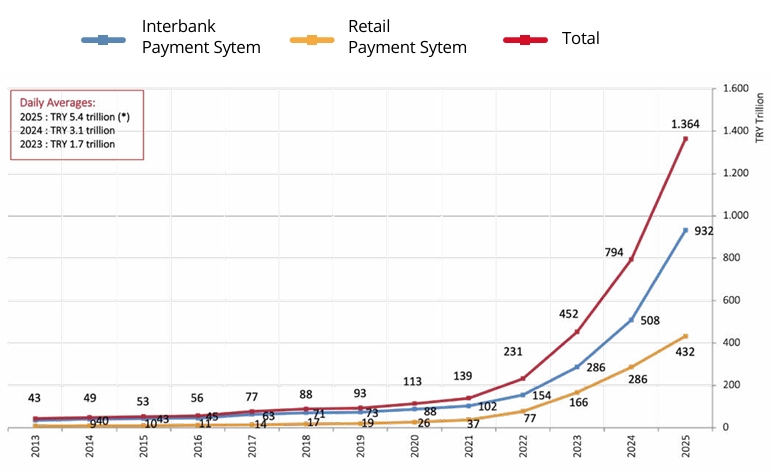
(*) TRY 3.7 trillion via the Interbank Payment System and TRY 1.7 trillion via the Retail Payment System.
Source: CBRT.Last Observation: Dec. 31, 2025
Chart 2.5.1.2: Total Number of Messages Processed Through CBRT Payment Systems (Million)
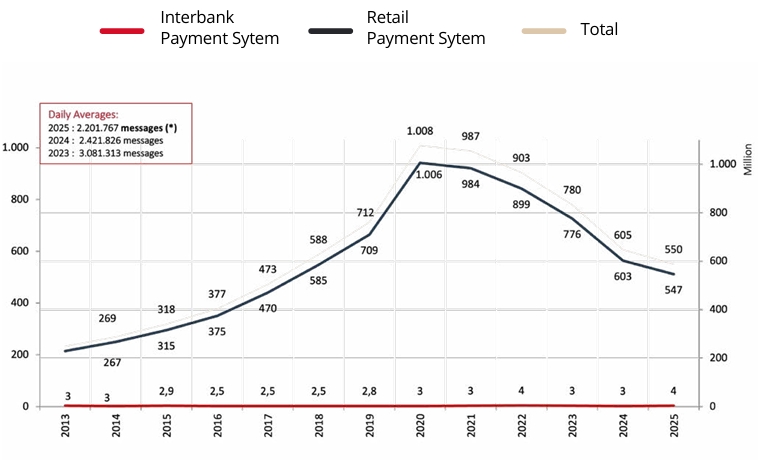
(*) 14,599 messages via the Interbank Payment System and 2,187,168 messages via the Retail Payment System.
Source: CBRT.Last Observation: Dec. 31, 2025
2.5.2 The Instant and Continuous Transfer of Funds (FAST) System and Statistics of Use
Developed by the CBRT and launched on January 8, 2021, the instant payment system (FAST) is one of the major endeavors of the CBRT to modernize Türkiye’s payment systems infrastructure to support innovative business solutions. With the FAST System, which operates 24/7, end-to-end transfers of retail payments are completed within seconds, and the end users are instantly notified.
The limits set in 2024 for FAST transaction amount (TRY 100,000) and merchant payments using dynamic QR codes (TRY 250,000) remained unchanged in 2025.
The Easy Addressing System (KOLAS) allows money transfers on the FAST System using telephone numbers, ID numbers, email addresses, passport numbers or tax numbers, removing the need to use the International Bank Account Number (IBAN). The number of individual customers of the KOLAS System was 26 million as of December 31, 2025.
The FAST System also allows person-to-person money transfers and merchant payments through the TR QR Code created in accordance with the standards, without necessitating IBAN information. The FAST-TR QR code enhancements enabled merchant payments to be carried out by scanning TR QR codes generated on domestic devices via the mobile applications of cross-border institutions.
Thanks to the Security Overlay Service (SIPER), illicit transaction notifications can be shared between the initiating institution and the receiving institution in all fund transactions, including FAST.
The work on developing the second version of the Request-to-Pay Overlay Service — based on the principle that the payee requests payment from the payer prior to the transaction and the payer responds to this request — expanded the scope of the service through the introduction of new models and functionalities. With the second version, the “Accept Later – Pay Later” and “Accept Now – Pay Now” models were launched on January 18, 2025. While the first version primarily targeted retail payments, the second version broadened the use cases to include merchant and e-commerce payments. Additionally, the new version introduced the “Partial Payment”, “Early Payment”, and “Deferred Payment” functionalities to the Request-to-Pay Overlay Service. Finally, in the last quarter of 2025, the CBRT initiated analytical work to enable the use of recurring payments in the Request-to-Pay Overlay Service.
The Escrow Overlay Service allows purchase and sale of second-hand vehicles in a fast and secure manner.
All overlay services constitute important steps that contribute to ensuring that payments and money transfers can be carried out seamlessly, swiftly, and securely anytime and anywhere. Additionally, the CBRT was engaged in efforts to raise awareness of and promote the use of KOLAS, FAST TR QR Code, and the Request-to-Pay Overlay Service. In this context, the Bank published an informative Request-to-Pay animation on the website “Ödemelerin Merkezi” (https://odemelerinmerkezi.org) to inform the public.
In 2025, the total value of messages processed on the FAST System was TRY 43.23 trillion, corresponding to TRY 118.46 billion per day on average. In 2025, the number of transactions conducted via the system was 5.4 billion while the daily average number of messages processed was 14.8 million. The highest daily transaction volume for 2025 was recorded on September 15, with 28.7 million transactions (Chart 2.5.2.2).
The system had 49 participants as of December 31, 2025.
Chart 2.5.2.1: Value of Payments Processed on the FAST
System
(TRY Billion)
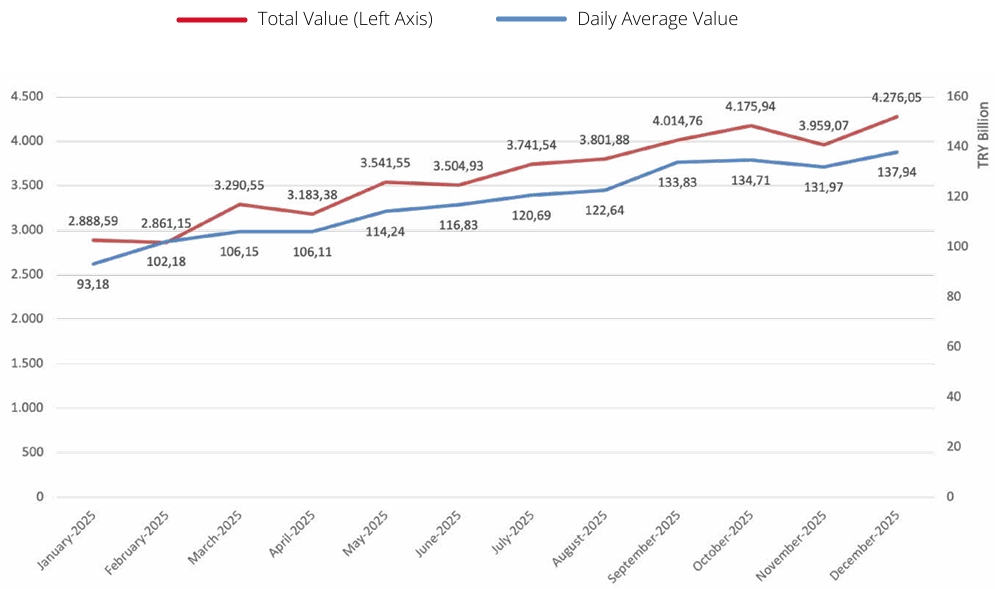
Source: CBRT.Last Observation: Dec. 31, 2025
Chart 2.5.2.2: Number of Messages Processed on the FAST System (Million)
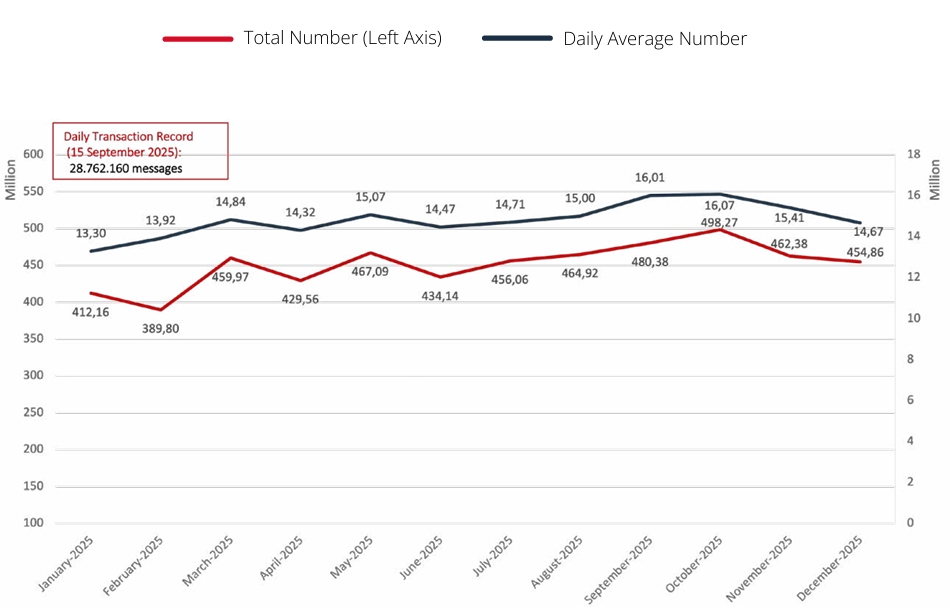
Source: CBRT.Last Observation: Dec. 31, 2025
2.5.3 Regulations Introduced Pursuant to the Law No. 6493
Risk Management Guidelines on Use of Services in Illegal Activities
The Guidelines on the measures to be taken and the procedures to be followed pursuant to Law No. 6493 in order to prevent the use for illegal activities of payment services offered by payment and electronic money institutions, were communicated to payment and electronic money institutions on November 6, 2025. The Guidelines define the minimum requirements to be used in the detection and monitoring of illegal activities, as well as the instructions to be followed regarding Application Programming Interface (API) integrations.
2025 Survey of Payment and Electronic Money Institutions
While continuing the statutory supervision of payment and electronic money institutions, the CBRT conducted a detailed data compilation and analysis covering 86 institutions to obtain an overview of the sector’s information systems infrastructure and processes, serving as a guide for future regulatory and supervisory activities.
Payment Institutions Supervision Monitoring System
The “Payment Institutions Supervision Monitoring System (OKDS)” application was launched to enable operators and payment and electronic money institutions to submit, and for the CBRT to monitor, reports specified in the Communiqué on Information Systems of Payment and Electronic Money Institutions and Data Sharing Services of Payment Service Providers in the Field of Payment Services, particularly independent audit reports on information systems.
Publication of the Communiqué on Redetermination of Minimum Own Funds Amounts for Payment and Electronic Money Institutions
The first paragraph of Article 33 bearing the title “Minimum own funds liability and professional indemnity insurance” of the Regulation on Payment Services, Electronic Money Issuance, and Payment Service Providers (Payment Services Regulation) states that the amounts of minimum own funds shall be re-evaluated by the CBRT in January every year, taking into account the annual changes in the price indices published by TURKSTAT.
In this context, as per the “Communiqué on Redetermination of Minimum Own Funds Amounts for Payment and Electronic Money Institutions” published in the Official Gazette No. 32798 dated January 30, 2025, the minimum own funds amounts for payment institutions that exclusively intermediate invoice payments, payment institutions other than those that exclusively provide account information services, and electronic money institutions were set at TRY 15 million, TRY 30 million and TRY 80 million, respectively, effective from June 30, 2025.
Implementation of the TR QR Code Regulation
The CBRT monitored the payment service providers’ process of building the technical infrastructure for TR QR Code transactions pursuant to the Regulation on the Generation and Use of TR QR Code in Payment Services, and worked in coordination with related stakeholders, the Interbank Card Center (BKM) in particular, to spread the use of TR QR Code in payments. As a result of the technical development and expansion work, card payments can be made using a TR QR Code at 90% of the existing POS machines and money can be withdrawn using a TR QR Code from almost all ATMs in Türkiye. Meanwhile, the ratio of POS machines allowing for payments using a FAST TR QR Code has exceeded 41%, which is expected to increase further once the payment service providers activate FAST TR QR Code payments at merchants.
To help expand this facility, an instruction was issued on August 29, 2025, to ensure that FAST System participants that have completed the required enhancements under the Transitional Provisions of the FAST TR QR Code Technical Principles and Rules Guide finalize the necessary contractual processes, enabling merchants that already accept payment cards to also receive payments via FAST TR QR Code.
In addition, to enable tourists visiting Türkiye to use TR QR Code—an innovative payment method alongside existing options—the underlying operational flows were defined in coordination with the BKM. These flows were made available to the use of payment service providers by incorporating them into the FAST TR QR Code Technical Principles and Rules Guide for payments to be carried out via the FAST System, and into the BKM (Card Payments) TR QR Code Technical Principles and Rules Guide for payments to be executed through the BKM’s card payment system.
Regulatory Amendments on Expanding the Scope of the Account Servicing Payment Service Provider Obligation under Open Banking Services and Extending Compliance Deadlines for Digital Wallet Services
Under the Regulation Amending the Regulation on Payment Services, Electronic Money Issuance and Payment Service Providers, and the Communiqué Amending the Communiqué on Information Systems of Payment and Electronic Money Institutions and Data Sharing Services of Payment Service Providers in the Field of Payment Services—published in the Official Gazette No. 32855 dated March 28, 2025, and entering into force on the same date—the CBRT revised the scope of account servicing payment service providers and the compliance deadlines for the obligations stipulated in the legislation for those providers designated within this scope.
Moreover, this revision extended the compliance deadlines for entities providing digital wallet services prior to the effective date of Article 4/A of the Regulation, which could be classified as payment or electronic money institutions, as well as for existing institutions, to ensure adherence to the provisions of the said article
Instruction on the Increase of Mobile Payment Limits
Under Article 12, paragraph 1(d) of Law No. 6493, a “payment transaction in which the sender’s consent to execute the payment is provided through an information or electronic communication device, and the payment is made to an information or electronic communication operator acting solely as an intermediary between the payment service user and the goods or services provider” is defined as a payment service.
The Payment Services Regulation prepared by the CBRT under Law No. 6493, was published in the Official Gazette No. 31676 dated December 1, 2021, and entered into force on the same date. The third paragraph of Article 16 of the Regulation, titled “Prohibition on Extending Credit” stipulates that:
“(3) The institution is required to conduct a risk assessment of its customers—based on all available inquiries, in particular their bill payment behavior—regarding payment transactions carried out by reflecting the amount intermediated under subparagraph (d) of the first paragraph of Article 4 onto the invoice issued by the information or electronic communication operator acting as an intermediary. Based on the results of this assessment, the institution is obliged to set upper limits, within the scope of the second paragraph, for payments to be made on behalf of the customer, both on a per-transaction basis and in terms of the total monthly spending amount across all lines held by the customer with the relevant electronic communication operator. The upper limits to be determined pursuant to this paragraph may not exceed TRY 1,000 per transaction and TRY 2,750 for the total monthly spending across all lines held by the customer with the relevant electronic communication operator. The Bank is authorized to increase these limits by up to threefold.”
Having assessed the matter, the CBRT decided to apply, within the scope of this provision, the limits—previously set at TRY 1,000 per transaction and TRY 2,750 for the total monthly spending across all lines held by the customer with the relevant electronic communication operator—as TRY 2,500 and TRY 6,500, respectively and issued its Instruction on July 4, 2025, accordingly.
Revision to the Scope of Institutions Qualifying as System Operators of Which the Bank Is a Shareholder in the Payment Services Regulation
Revisions to the Regulation on Payment Services, Electronic Money Issuance and Payment Service Providers regarding the provisions applicable to payment services and electronic money issuance offered by institutions qualifying as system operator, of which the Bank is a shareholder, were published in the Official Gazette No. 33124 dated December 31, 2025, and entered into force on the same date.
Work on the Open Banking Gateway (GEÇİT) Infrastructure of Data Sharing Services in the Field of Payments (DSSP)
As of end-2025, a total of 39 payment service providers comprising 34 banks and five electronic money institutions have completed their technical certification via the BKM API Gateway (GEÇİT)¹, which was launched on December 1, 2022 and assigned as the common DSSP infrastructure, and are serving as Account Servicing Payment Service Providers (ASPSPs). In addition to their role as ASPSPs, banks, if they wish, can also integrate in the system as Authorized Third-Party Payment Service Providers (TPPs) pursuant to first paragraph of Article 13 of the Law No. 6493. On the other hand, unlike other payment service providers, banks do not have to get an operating license from the CBRT as they are subject to the Banking Law No. 5411. Currently, 24 banks serve as TPPs
If the existing payment and electronic money institutions want to serve as TPPs, they should get a license for expansion of activities in addition to the technical certification of the BKM pursuant to subparagraphs (f) and (g), paragraph one of Article 12 of the Law No. 6493, while other institutions (that are not payment institutions) should get an operating license. Accordingly, eight non-bank payment service providers successfully completed their technical certification and license procedures, and have integrated with the GEÇİT infrastructure as TPPs. Including the banks that have become TPPs, the number of TPPs has reached 41. On the other hand, procedures for some institutions to become TPPs continue. Participants in the production environment (ASPSPs and TPPs) and participants that completed the BKM Technical Certification processes are listed on the website built for the DSSP².
To ensure safe completion of regulatory compliance by payment service providers as well as smooth conclusion of the related technical and operational work, and in view of the sector’s demands, the transition period deadline was set as December 31, 2025, for payment service providers that are FAST participants, together with non-participants that provide direct online access to customers and are among the top 10 payment and electronic money institutions in terms of annual transaction volume, based on the latest amendments to the secondary regulations published in the Official Gazette No. 32855 dated March 28, 2025.
Unlike the first version 1.0.2, the currently operational 1.1.0 version of the DSSP API Standard includes the Adding a Credit Card to the Digital Wallet, the Event Reporting and Event Subscription Services, and Decoupled Strong Customer Authentication flows. In addition to enhancements to existing functions, studies continue for Future-Dated Payments, Recurring Payments, and Card Info and Movements to be included in the standard. These new features will become operational in 2026 with the launch of the 2.0.0 version.
2.5.4 Licenses Regarding the Activities of Payment and Securities Settlement Systems
Number of Payment and Securities Settlement Systems Operating in Türkiye
As of December 31, 2025, there were eight payment systems and four securities settlement systems operating in Türkiye pursuant to the Law No. 6493.
Transfer of Shares
The application for the transfer of shares submitted by a system operator was approved.
2.5.5 Licenses Regarding the Activities of Payment and Electronic Money Institutions
Operating License
- Operating license applications of five companies were approved and published in the Official Gazette.
Expansion of Activities
- Six institutions’ applications for expansion of activities were approved and published in the Official Gazette.
Transfer of Shares
- Applications from seven institutions for transfer of shares were approved.
Suspension of Operating License
- Operating licenses of 14 institutions were suspended.
Revocation of Operating License
- Operating licenses of seven institutions were revoked.
Rescission of the Decision to Revoke an Operating License
- The decision to revoke the operating license of one institution was rescinded.
Termination of Operating License Automatically
- Operating licenses of two institutions were terminated automatically due to a merger.
External Service Providers That Were Granted Eligibility to Provide Community Cloud Service
As per paragraph seven, Article 16 of the Communiqué on Information Systems of Payment and Electronic Money Institutions and Data Sharing Services of Payment Service Providers in the Field of Payment Services, six external service providers were granted eligibility to provide community cloud service to payment and electronic money institutions. The CBRT oversees the community cloud services provided by these external service providers.
In 2025, approval was granted to nine additional payment and electronic money institutions that applied to use community cloud services in these environments. In addition, community cloud environments used by licensed payment and electronic money institutions may, subject to the CBRT’s approval, also be utilized by credit or financial institutions whose IT-related activities are regulated and supervised by a competent authority under the relevant legislation. Accordingly, two financial institutions have started to use these services.
Number of Payment and Electronic Money Institutions Operating in Türkiye
As of December 31, 2025, there were 24 payment institutions and 62 electronic money institutions operating in Türkiye pursuant to the Law No. 6493.
2.5.6 Administrative Sanctions Imposed on Payment and Electronic Money Institutions
Following the oversight and supervision activities carried out at institutions in 2025, 72 institutions were charged with administrative fines amounting to TRY 373.2 million in total and 29 institutions received a warning pursuant to Article 27 of the Law No. 6493 titled “Violation of Regulations and Decisions”.
1 https://www.tcmb.gov.tr/wps/wcm/connect/TR/TCMB+TR/Main+Menu/Duyurular/Basin/2022/DUY2022-48
2 https://bkm.com.tr/en/products-and-services/data-sharing-services-in-the-field-of-payment/