2.2 Operational Framework of Monetary Policy
2.2.1 Turkish Lira Liquidity Management
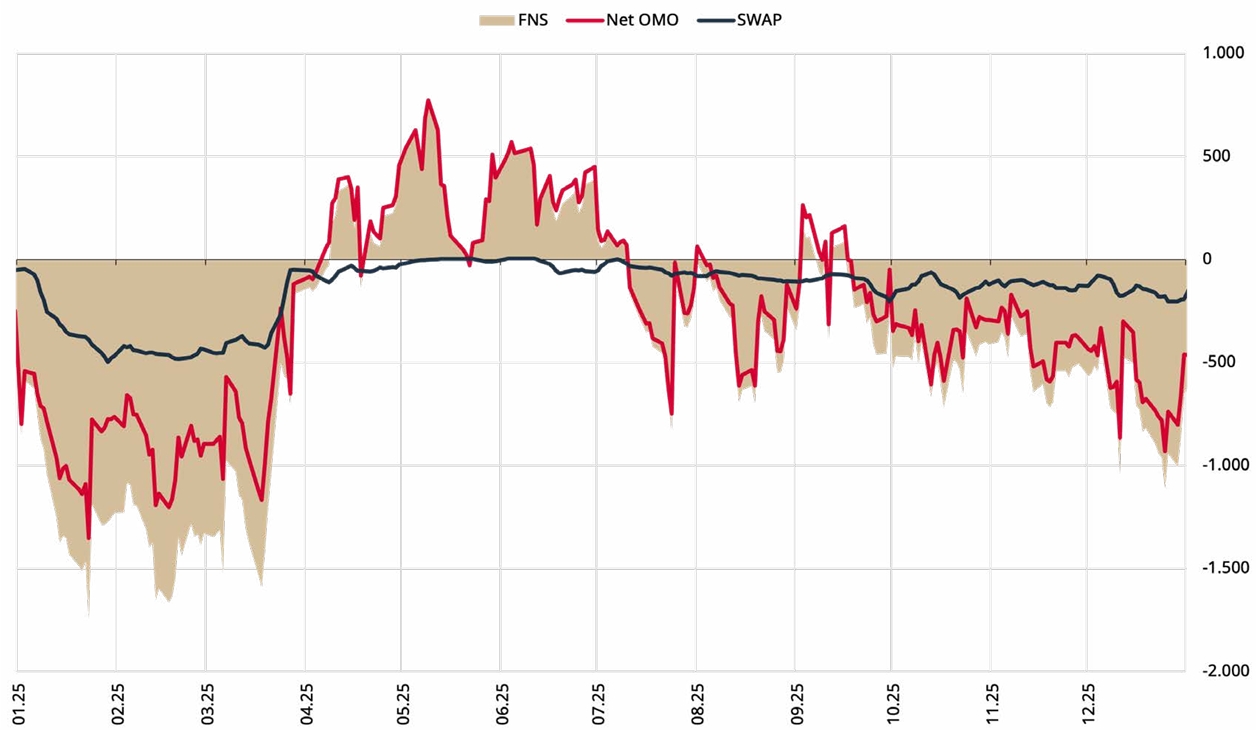
At the beginning of 2025, the excess liquidity amounted to TRY 846 billion, while the funding need of the system (FNS) shifted to a liquidity shortage temporarily in the April-July period. As of early July, the excess liquidity became permanent again and stood at TRY 653 billion on December 31, 2025. This excess liquidity was sterilized through net open market operations (OMO) of TRY 461 billion and swap auctions of TRY 192 billion (Chart 2.2.1.1).
In 2025, the TRY 192-billion decline in the FNS was primarily driven by the change in the money base due mainly to the maintenance of required reserves. Additionally, the change in the amount of net domestic borrowing of the Ministry of Treasury and Finance of the Republic of Türkiye also lowered the excess liquidity in the system.
Chart 2.2.1.1: CBRT Funding (TRY Billion)
Source: CBRT.
In 2025, to bolster the effectiveness of the monetary transmission mechanism, the excess liquidity in the market was sterilized through the diversified liquidity toolset.
Accordingly;
- At the CBRT, Turkish lira deposit buying auctions, sell-side Turkish lira currency/gold swap auctions and Interbank Money Market (IMM) deposit transactions were held.
- Quotation repo transactions at the BIST Repo/Reverse Repo Market and the Committed Transactions Market as well as quotation at the Takasbank Money Market (TMM) were used.
- Moreover, liquidity bills within the sterilization toolkit were issued. To this end, liquidity bills amounting to TRY 269 billion with a maturity of approximately 1 month were issued in the March 24 - April 4 2025 period.
In order to maintain instrument diversity and operational flexibility in liquidity management, the CBRT is required to hold a sufficient amount of GDDS and Turkish lira-denominated lease certificates issued by the Undersecretariat of Treasury Asset Leasing Company of the Ministry of Treasury and Finance (HMVKŞ) in its OMO portfolio. In accordance with this requirement, nominal TRY 0.8 billion of lease certificates and nominal TRY 123.7 billion of GDDS were added to the portfolio through the auctions in 2025. Thus, the size of the OMO portfolio was nominal TRY 262.3 billion as of end-2025, composed of lease certificates of nominal TRY 10.0 billion and GDDS of nominal TRY 252.3 billion.
2.2.2 Foreign Exchange Liquidity Management
The CBRT has no commitment to any exchange rate level under the current exchange rate regime. However, to ensure efficient functioning of the FX market and promote healthy price formation, in 2025 the CBRT continued to closely monitor exchange rate developments and related risk factors, as well as to take the necessary measures and employ suitable instruments. With a view to diversifying the toolset for sterilization of excess liquidity in the system throughout the year, gold and foreign currency-against TL swap auctions were held. Sell-side Turkish lira swap auctions continued until March under the liquidity management framework, and the outstanding amount of sell-side swaps was reduced to zero by March 27, 2025. Meanwhile, sell-side Turkish lira gold and currency swap auctions continued throughout the year, as of December 31, 2025, the net outstanding amount of sell-side swaps was 32.3 tons.
Turkish lira-settled FX forward selling transactions were carried out at the CBRT in March and May 2025. The amount of these transactions was reduced to zero as of July 25, 2025.
In October 2025, the CBRT suspended transactions to buy gold produced from ore against Turkish lira in view of market conditions, and conducted location swap transactions with banks in line with market conditions.
In line with developments in global interest rates, the interest rates on collateral FX deposits were gradually reduced from 4.50% to 3.50% for the U.S. dollar across all maturities, and from 3.25% to 2.00% for the euro across all maturities. The interest rates on foreign currency deposits that banks can obtain from the CBRT were kept unchanged. These rates currently stand at 7.00% for a 1-week term and 7.75% for a 1-month term for the U.S. dollar, and 5.50% for a 1-week term and 6.00% for a 1-month term for the euro.
2.2.3 Reserve Requirements
To enhance the functionality of the market mechanism, strengthen macro-financial stability and support the monetary transmission mechanism, the CBRT continued to employ reserve requirements (RR) in 2025 intensively. Accordingly, the targets for the phase-out of the KKM program, adjustments to RR ratios applied to liabilities denominated in Turkish lira and foreign currency, the reserve requirements based on credit growth, and targets for the share of TRY deposits were utilized as a policy set.
Termination of the FX-Protected Deposit Accounts
As a result of the regulations implemented to phase out the FX-Protected Deposit Accounts (KKM) in a gradual and controlled manner starting in August 2023, the KKM scheme was fully terminated in 2025. During this process, variables such as targets for the conversion and renewal of KKM accounts into term Turkish lira deposits, the RR and interest/compensation payment rates applied to KKM accounts, and the minimum interest rate applicable to KKM accounts were frequently revised in line with financial conditions.
As of January 20, 2025, openings and renewals of 6- and 12-month KKM accounts were discontinued. As of February 15, 2025, opening and renewal of KKM accounts (including YUVAM accounts) by legal entities were discontinued, and legal entity KKM accounts were excluded from the targets related to the transition of KKM to TRY and its renewal. On June 21, 2025, the RR rate applicable to KKM accounts with terms of up to 6 months was raised from 33% to 40%, and the minimum interest rate set for KKM accounts was lowered. On the same date, while the target for the transition from KKM to TRY was removed, the overall target regarding the renewal of KKM and its transition to TRY was maintained. On August 23, 2025, the opening and renewal of KKM accounts (excluding YUVAM accounts) were discontinued also for individuals. With this decision, the overall target regarding the conversion of KKM to Turkish Lira and its renewal was removed, and the interest/compensation and commission regulations for RR were reviewed. As a result of these measures, the KKM balance, which had reached USD 143 billion as of August 2023, receded levels hovering around zero by the end of 2025.
Turkish Lira Liabilities and Required Reserves
On February 4, 2025, the RR ratio applied to funds from repo transactions from abroad, loans obtained from abroad, and deposits held at foreign banks—all related to banks’ Turkish lira-denominated liabilities with maturities of up to one year—was raised from 8% to 12%. On May 24, 2025, this ratio was differentiated by maturity for funds obtained through foreign repo transactions and loans drawn from abroad; it was set at 18% for maturities of up to 1 month and 14% for maturities of up to 3 months.
While as of June 21, 2025, opening floating-rate TRY deposit accounts with maturities longer than one month was facilitated, the reserve requirement ratio applied to floating-rate accounts indexed to the Consumer Price Index (CPI), the Producer Price Index (PPI), and the TLREF has been set at 10% for all maturities. On April 26, 2025, it was decided to calculate the interest or compensation paid on required reserves maintained for TRY deposits based on the CBRT’s weighted average funding cost (WAFC) rather than the policy rate; starting May 3, 2025, these payments began to be made at a rate of 86% of the WAFC instead of 84%.
Foreign Currency-Denominated Liabilities and Required Reserves
On May 3, 2025, RR ratios for FX deposits/participation funds (excluding deposits/participation funds at foreign banks and including precious metal accounts) were raised by 200 basis points and the RR ratio for funds derived from FX repo transactions with residents of a maturity up to 1 year was raised by 400 basis points to 25%. On June 21, 2025, the RR ratio for FX deposits/ participation funds to be maintained in Turkish lira was reduced from 4% to 2.5%. The press release of December 4, 2025 announced simplification steps regarding required reserves. In this context, the provisional arrangement setting the reserve requirement ratio at zero percent until the end of the year for the amount of increase in foreign currency (FX) liabilities with maturities longer than one year that banks and financing companies obtain directly from abroad was no more subject to an extension and expired as of December 19, 2025. Taking the effects of this decision into account, RR ratios for FX were revised, and equalized for deposits/participation funds for FX and precious metal accounts, while those for other FX liabilities with maturities longer than 1 year were reduced. Moreover, liabilities of financing companies against domestic banks were excluded from the reserve requirement scheme.
Loan Growth-Based Reserve Requirement Practice
The loan growth-based reserve requirement practice was also subject to changes in 2025 with a view to ensuring that loan growth and composition support the disinflation process and the monetary transmission mechanism. On January 4 ,2025, the monthly growth limit for foreign currency loans was reduced to 1% from 1.5%. On the same date, the 2% monthly growth limit for Turkish lira commercial loans was differentiated as 2.5% for SME loans, and 1.5% for other commercial loans. On March 1, 2025, the monthly growth limit for foreign currency loans was reduced to 0.5% from 1%. On August 16, 2025, the loan growth calculation period was increased from 4 weeks to 8 weeks and growth limits were doubled accordingly.
Loan types subject to exemption regarding growth limits were revised throughout the year. Accordingly, one of the notable changes was the exemption of Turkish lira SME loans from the loan growth limit that are extended through the Small and Medium Enterprises Development Organization (KOSGEB) or in the scope of funding provided by international development finance institutions to support sustainability on January 4, 2025. Moreover, on March 1, 2025, the scope of investment loans that are exempt from the growth limit for foreign currency loans was narrowed and foreign currency loans disbursed for the earthquake zone were excluded from exemption.
On March 28, 2025, overdraft accounts with more than three installments (excluding education and tuition fees)—which were previously exempt from the limit of general purpose loans—have been included in the limits on loan growth.
The implementation period of the loan growth-based reserve requirement practice was extended until the end of 2026.
TRY Deposit Share Targets
The Turkish lira deposit share targets, implemented to increase the share of Turkish lira deposits within total deposits, were revised across the year in line with financial conditions. As of the year-end, the monthly increase targets for the TRY deposit share were set at 0.2 percentage points for banks with a share of 60–65% in TRY deposits held by real persons, and 0.4 percentage points for banks with the same share below 60%; and 0.3 percentage points for banks with the share of TRY deposits held by corporate customers below 60%. The share of TRY deposits hovered above 60% at the end of the year.
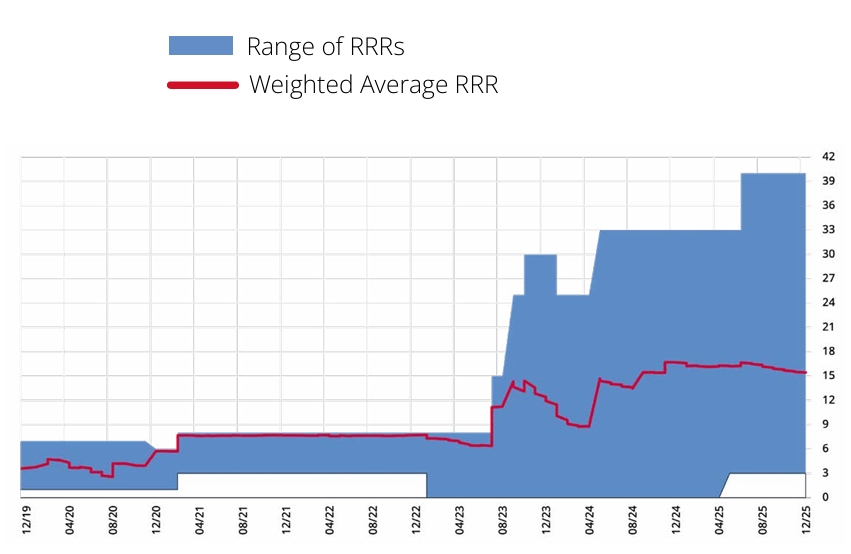
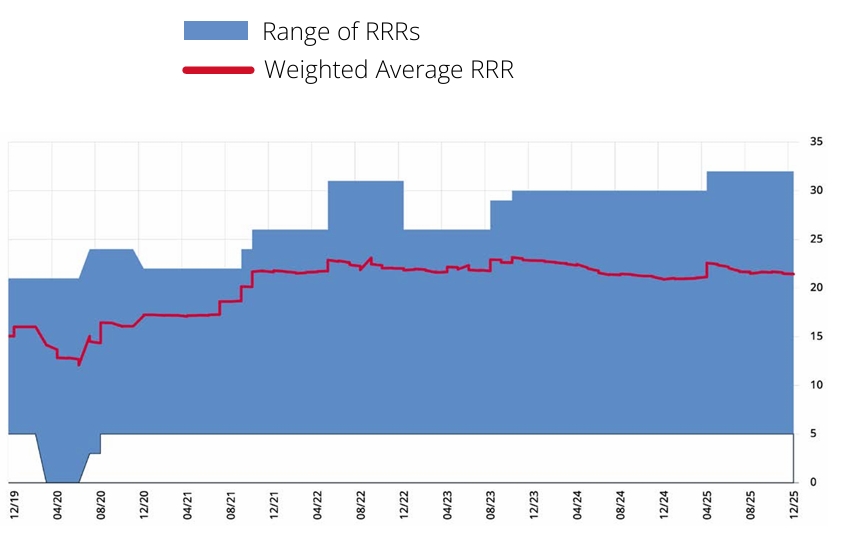
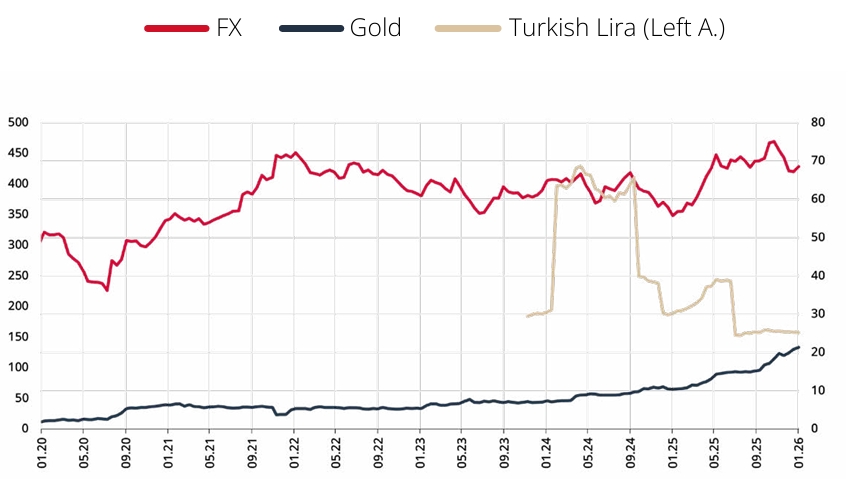
As of the calculation date of December 19, 2025, the weighted average TRY and FX RR ratios became 15.4% and 21.4%, respectively (Charts 2.2.3.1 and 2.2.3.2).
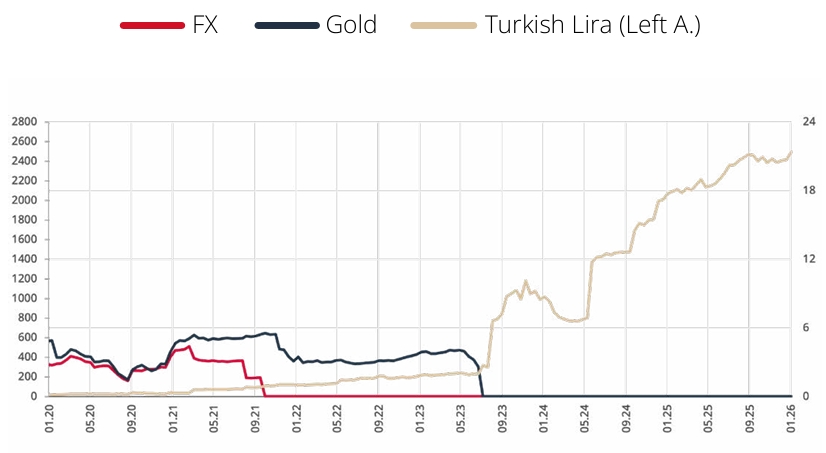
As of the calculation date of December 19, 2025, Turkish lira liabilities subject to reserve requirements amounted to TRY 31.824 billion, and FX liabilities amounted to TRY 16.235 billion. As of the maintenance period of January 2, 2026, TRY 2.497 billion is held for TRY liabilities, USD 68.6 billion worth of FX and USD 21.4 billion worth of gold have been maintained for FX liabilities (Charts 2.2.3.3 and 2.2.3.4). As of the maintenance period of January 2, 2026, the amount of additional RR required to be maintained in TRY for FX deposits/participation funds (excluding deposits/participation funds of banks abroad and precious metal accounts) is TRY 157.6 billion. On the other hand, the maintained amount based on Turkish lira loan growth is TRY 10.6 billion TL, while the maintained amount based on FX loan growth is TRY 0.5 billion.
Chart 2.2.3.1: RR Ratios for TRY Liabilities (%, as of Calculation Periods)
Source: CBRTLast Observation: 19.12.2025
Chart 2.2.3.2: RR Ratios for FX Liabilities
*
(%, as of
Calculation Periods)
Source: CBRTLast Observation: 19.12.2025
*Additional RR ratio to be maintained in Turkish lira for FX deposits is 2.5% in all maturities and is not indicated in the chart.
Chart 2.2.3.3: RR Amounts for TRY Liabilities (TRY Billion, USD Billion, as of Maintenance Periods)
Source: CBRT Last Observation: 02.01.2026
Chart 2.2.3.4: RR Amounts for FX Liabilities (USD Billion, as of Maintenance Periods)
Source: CBRTLast Observation: 02.01.2026
2.2.4 Rediscount Credits
Governed by Article 45 of the CBRT Law No. 1211, rediscount credits for exports and FX earning services are extended to exporters and firms that engage in FX earning services and activities to finance them at affordable costs. These loans are made available at maturities of up to 360 days by accepting Turkish lira and FX-denominated bills for rediscount via intermediary banks based on the Turkish lira equivalent of the bills. Repayments to the CBRT are made in either FX or Turkish lira, depending on the currency of the issued bills.
Firm-based credit limits were determined as: for Small and Medium-Sized Enterprises (SMEs), half the maximum annual net sales revenues or financial balance sheet amounts set for micro, small, and medium-sized enterprises in subparagraphs (a), (b), and (c) of the first paragraph of Article 5 of the “Regulation on Small and Medium-Sized Enterprises” published in the Official Gazette of May 25, 2023 and No. 32201, TRY 4.5 billion for firms engaged in FX earning services, export intermediaries and firms operating in the defense industry, and TRY 2.5 billion for other firms.
In 2025, the following changes were made in the rediscount credit implementation:
- On March 3, 2025, a new mechanism was established to enable the Export Credit Bank of Türkiye (Türk Eximbank) to present promissory notes issued by exporting firms that are customers of participation banks to the CBRT for rediscounting, and the obtained financing to be extendable to these firms through the participation banks.
- On May 5, 2025, in accordance with the Electricity Market Law No. 6446 of March 14, 2013, and the regulations issued pursuant to this Law, amendments were made to allow the provision of rediscount credits to companies holding electricity market distribution licenses through the acceptance of promissory notes denominated in Turkish lira for rediscounting.
- On August 1, 2025, the companies operating in the defense industry sector, which had availed themselves of the maturity extension option and currently hold unmatured FX rediscount credits, were allocated a foreign currency rediscount credit limit equivalent to the USD value of their bills within this scope.
- On October 23, 2025, the daily limits for TRY- denominated rediscount credits were increased by TRY 500 million, bringing the total to TRY 4.5 billion effective as of November 1, 2025. The daily limit per company was raised to TRY 60 million.
- On October 24, 2025, the requirement for companies to refrain from purchasing FX for TRY-denominated rediscount credits was repealed and replaced with a requirement for companies to maintain their FX position ratios at 10% or below throughout the term of the loan to be effective as of November 1, 2025. In addition, the company limit for FX rediscount credits disbursed under additional article 4 of the Implementation Guidelines was increased from USD 1.5 million to USD 5 million.
In 2025, a total of TRY 1,033.42 billion of rediscount credits for export and FX earning services were extended with a breakdown of TRY 136 billion in FX and TRY 896 billion in Turkish lira.
In 2025, rediscount credits totaling approximately CNY 4 billion (USD 557.31 million) were extended under currency swap agreements to finance trade or investment activities between the Republic of Türkiye and the People’s Republic of China in local currency.
In line with the measures taken to bolster food supply security, rediscount credits of TRY 400 million with a maturity of maximum 360 days were extended to companies producing food products or agricultural products for the domestic market and/ or supplying the inputs necessary for the production of such products, through the acceptance of Turkish lira-denominated promissory notes for rediscounting in 2025.
In accordance with the Electricity Market Law No. 6446 of March 14, 2013, and the regulations issued pursuant to this Law, the CBRT deemed it appropriate to extend rediscount credits to companies holding an electricity market distribution license through the acceptance of Turkish lira-denominated promissory notes for rediscounting until December 31, 2025. Under the rediscount credit package extended to electricity distribution companies, a total of TRY 22.5 billion in loans was disbursed to 12 companies.
2.2.5 Advance Loans
Advance Loans Against Investment Commitment (ALAIC) are extended pursuant to Article 45 of the CBRT Law No. 1211 through intermediary banks to firms for financing large-scale, high-tech, and strategic investments by accepting TRY-denominated bills for advance, at a maximum maturity of 10 years and with a maximum grace period of two years. The ALAIC program was allocated an annual limit of TRY 100 billion.
By December 2025, the following changes have been made in the ALAIC implementation:
- On March 24, 2025, regarding the allocation and utilization procedures of ALAIC, it was decided to consider the size of the project in the evaluation the Technology and Strategy Score (TSS), which is given by the Ministry of Industry and Technology of the Republic of Türkiye. Moreover, for the investments of firms with a TSS of 85 and above, an additional limit of TRY 5 billion was introduced, provided that the project size does not exceed 70% of the size recorded in the TSS certificate.
- On May 30, 2025, taking account of the size of the added values of investments with high TSS, to provide these investments with sufficient financing at reasonable costs, allocation of the whole of the firm-based credit limit was enabled for investment projects with TSS of 85 and above.
- On June 23, 2025, regulations were introduced to allow the use of ALAIC with a variable interest rate that tracks changes in the policy interest rate rather than a fixed interest rate.
- On October 23, 2025, to prevent any disruptions in the disbursement of ALAIC with intermediated by participation banks, the utilization of fixed-rate ALAIC was enabled alongside the variable-rate ALAIC.
In 2025, TRY 21.20 billion was used out of the total loan allocation of TRY 40.51 billion in advance loans against investment commitments to investing firms through banks.