2.7 International Reserves and Risk Management
The CBRT holds international reserves in support of a range of objectives that include assisting the government in FX-denominated domestic and foreign debt servicing, maintaining adequate FX liquidity against external shocks, supporting monetary and exchange rate policy implementation, and enhancing market confidence. The CBRT’s reserve management practices are governed by the CBRT Law No. 1211. Pursuant to this law, international reserves are managed by the CBRT in consideration of the three priorities as investment safety, liquidity, and return respectively. Accordingly, the objective of management of international reserves is to generate returns under the constraints of protecting capital and providing the necessary liquidity, with the ultimate aim being the prudent management of reserves as the country’s national wealth.
The CBRT’s reserve management is based on regulations approved by the Board and the benchmark portfolio approved by the Executive Committee. Management of risks that the CBRT may be exposed to during the conduct of its reserve management operations begins with the determination of the benchmark portfolio. Reflecting the CBRT’s preferences for strategic asset allocation, the benchmark portfolio specifies the currencies to invest in and the instruments and maturities to be employed in reserve management, thereby allowing identification of the expected return and the financial risks involved to a large extent. The Reserve Management Division of the Markets Department is in charge of reserve management, while the Financial Risk Management Division handles the associated risk management.
In 2025, global financial markets were shaped by the decline in inflation in advanced economies, cautious rate-cut cycles guided by economic activity and labor market data, policy divergence among central banks, and geopolitical and political developments. Throughout the year, financial asset pricing remained highly sensitive to economic data and central bank communication. The resilient growth performance of the US economy led the Fed to continue its rate cuts in a gradual and data-driven manner. Despite the decline in short-term interest rates, long-term government bond yields increased across advanced economies, driven by concerns over debt sustainability and political developments, leading to a steepening of yield curves. The US dollar index assumed a downtrend, as yield spreads narrowed against the US dollar in line with policy divergence among advanced economy central banks, and political developments weakened safe-haven demand for the dollar. In parallel, the EUR/USD parity recorded a notable increase compared to end-2024. In the euro area, the ECB shifted to a data-driven approach in the second half of the year, keeping policy rates unchanged in line with moderate growth dynamics and fiscal developments. Meanwhile, concerns over fiscal discipline and political uncertainties caused volatility in sovereign yield spreads across euro area countries. In Asia, the Bank of Japan’s ongoing normalization process, together with political developments, pushed Japanese government bond yields higher, while feeding market volatility through global interest rate differentials and exchange rate channels. In China, weak domestic demand and structural problems in the real estate sector continued to weigh on the growth outlook, and bond yields remained at low levels despite fiscal and monetary support measures. While gold performed strongly amid rate-cut expectations, geopolitical and political risks, concerns over the independence of the Fed, and central banks’ purchases, becoming a primary hedge in portfolios, energy prices showed fluctuations due to the global demand outlook. In general, 2025 stood out as a period in which central banks’ rate cuts and policy divergence, fiscal discipline debates, as well as political and geopolitical risks were priced-in altogether, and which was marked by elevated uncertainty. The CBRT’s reserve management strategies in 2025 were also shaped by these developments. In this period of elevated global economic and financial risks, the CBRT continued to carry out its reserve management in line with monetary policy objectives and practices, prioritizing safe investment, liquidity and return, respectively.
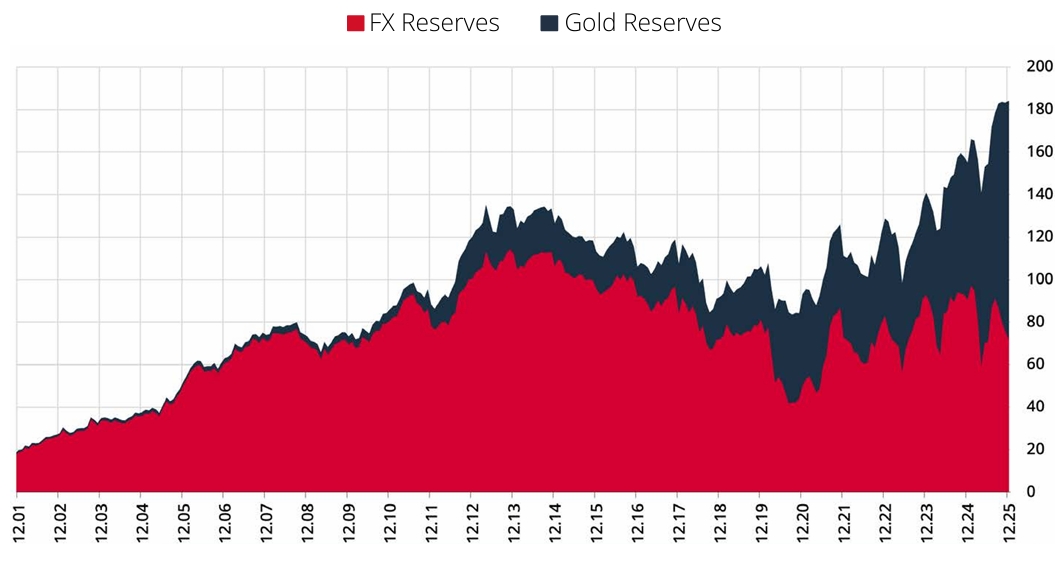
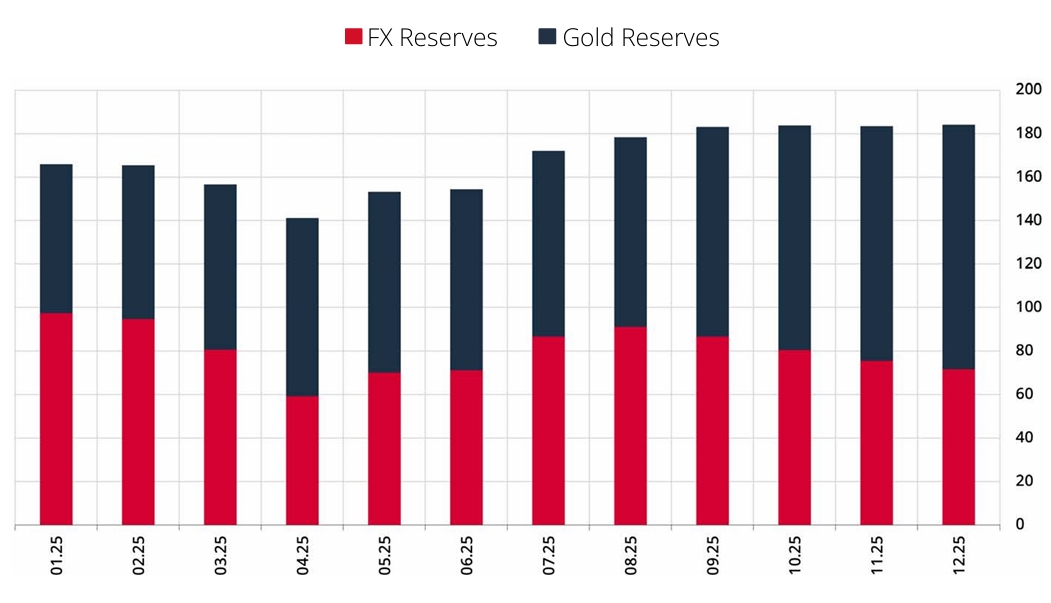
In 2025, the Bank maintained its strategy to strengthen reserves as long as market conditions permitted and it did not conflict with the inflation target. The CBRT’s international reserves increased further in 2025, going up by USD 28.9 billion from the previous year to USD 184.1 billion as of December 31, 2025. Of this total, foreign currency reserves accounted for USD 71.7 billion and gold reserves for the remaining USD 112.4 billion. Making up 61% of total international reserves, the CBRT’s gold reserves of international standards amounted to 811.4 tons as of December 31, 2025 (Charts 2.7.1 and 2.7.2).
Chart 2.7.1: CBRT’s FX and Gold Reserves 2001-2025 (USD Billion)
Source: CBRT.Last Observation: December 31, 2025
Chart 2.7.2: CBRT’s FX and Gold Reserves in 2025 (USD Billion)
Source: CBRT.Last Observation: December 31, 2025